Here's a polished, reader-friendly blog version that improves flow, readability, and engagement while keeping your core message intact:
Housing Market Forecasts for 2026 Have Changed: Here's What That Means for Buyers and Sellers
If the housing market feels confusing right now, you're not alone.
Mortgage rates remain elevated. Home sales haven't accelerated the way many experts expected. And both buyers and sellers are wondering when conditions will become more affordable and predictable.
The reality is that a lot has changed during the first half of 2026.
At the end of 2025, economists were forecasting a much stronger year for housing. Many expected mortgage rates to decline, affordability to improve significantly, and home sales to rebound.
Instead, persistent inflation, economic uncertainty, and rising geopolitical tensions overseas have kept mortgage rates higher than anticipated. As a result, many would-be buyers have remained on the sidelines.
That's why housing experts have recently adjusted their forecasts for the remainder of the year.
So, what do these updated forecasts actually mean for you? Let's take a closer look.
Mortgage Rates May Stay Higher for Longer
While many buyers are hoping to see mortgage rates return to the upper 5% or low 6% range, most experts don't believe that will happen this year.
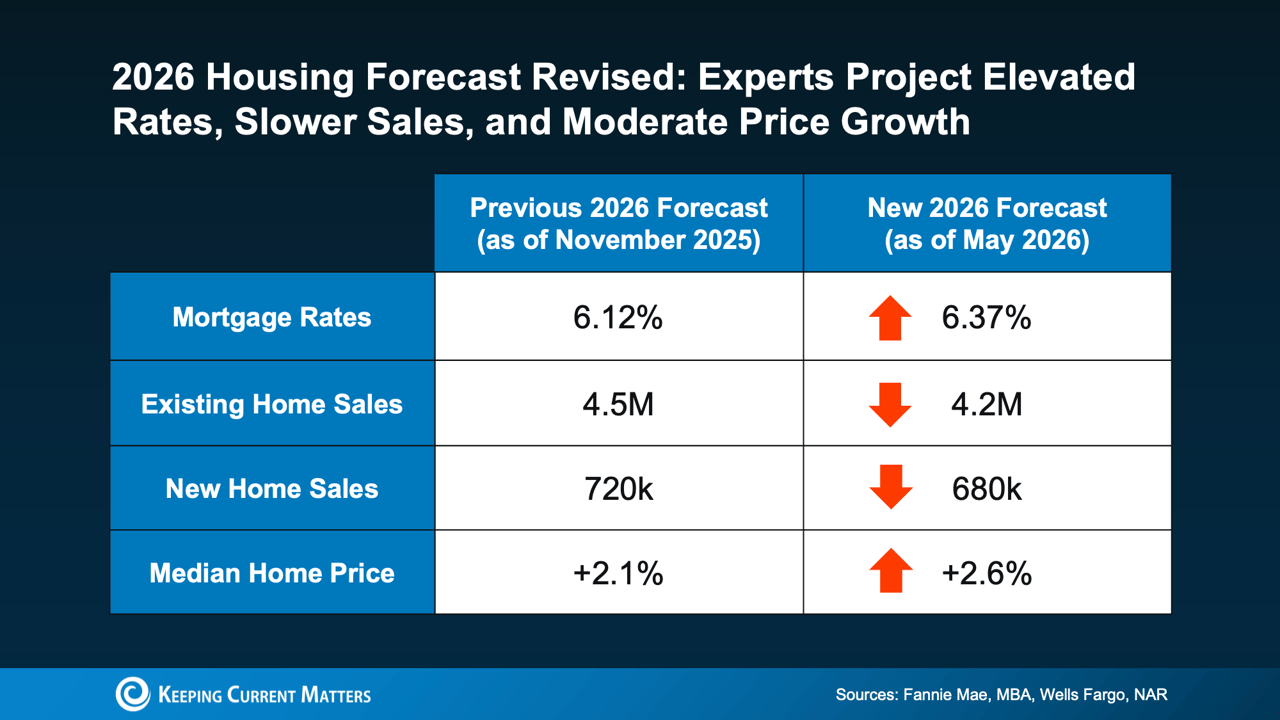
Forecasts that once projected rates in the low 6% range have now been revised upward, with many industry organizations expecting rates to remain in the mid-6% range through the rest of 2026.
The silver lining? Rates are still lower than they were a year ago.
Of course, forecasts can change. If inflation cools more quickly or geopolitical tensions ease, rates could improve. But waiting for significantly lower rates may not deliver the affordability gains many buyers are expecting.
Existing Home Sales Have Been Revised Downward
At the end of last year, economists expected existing home sales to reach approximately 4.5 million in 2026. Today, that forecast has been adjusted to roughly 4.2 million.
The reason is simple: affordability remains a challenge.
Higher mortgage rates continue to impact monthly payments, making homeownership more difficult for many buyers, especially first-time purchasers. As a result, buyer activity has remained more subdued than originally anticipated.
Even so, experts still expect more homes to sell this year than last year.
Many economists believe there is substantial pent-up demand waiting on the sidelines. Once mortgage rates stabilize and economic uncertainty fades, those buyers could quickly re-enter the market.
As Lawrence Yun, Chief Economist for the National Association of Realtors®, explains:
"There is sizable pent-up demand that could be released into the market."
There are already encouraging signs. Pending home sales have shown month-over-month improvement in recent months despite elevated mortgage rates.
For buyers who can comfortably afford a home today, purchasing now may offer advantages. Waiting could mean facing increased competition and fewer available homes once more buyers return to the market.
New Home Sales Have Slowed Too
Builders also entered 2026 expecting stronger demand.
Earlier forecasts projected new home sales would exceed 700,000 this year. Today, economists expect sales to come in slightly below that mark.
Again, mortgage rates are a key factor.
However, this creates an opportunity for buyers.
In many markets, builders remain motivated to move inventory, which means incentives, pricing flexibility, and negotiation opportunities may continue throughout the year.
If you're considering a newly built home, this could be one of the brightest opportunities in today's market. Builders may be more willing to negotiate, giving buyers additional leverage to secure favorable terms.
Home Prices Are Still Expected To Rise
Perhaps the most important takeaway from the latest forecasts is this:
Despite slower sales activity, experts have not significantly lowered their home price projections.
Nationally, home prices are still expected to appreciate in 2026.
Why?
While buyer demand has softened, housing inventory remains relatively limited in many parts of the country. That ongoing supply-and-demand imbalance continues to support home values.
Of course, real estate is local. Some markets are cooling more than others, while some continue to see strong price growth.
But on a national level, experts are still forecasting steady appreciation not a major decline.
That's welcome news for sellers concerned about protecting their equity. And for buyers, it provides reassurance that a home purchase is still likely to be a sound long-term investment.
Bottom Line
The housing market hasn't rebounded as quickly as many economists originally expected, but that doesn't mean the market is stalled.
Higher inflation, economic uncertainty, and global events have led experts to revise their forecasts for the remainder of the year. However, most economists still believe the market will regain momentum once those pressures begin to ease.
Rather than viewing these forecast revisions as a warning sign, consider them a reflection of today's economic conditions.
If you're wondering what these trends mean for your specific goals, the best next step is to connect with a local real estate professional who can help you understand what's happening in your market and guide you through your options for the rest of the year.